Jacob Zuma's Nkandla home: South African papers defy photo ban

South African newspapers have published images of President Jacob Zuma's residence, defying a government warning that this would break security laws. 
 The Star newspaper
Mr Zuma's Nkandla residence is at the centre of a row after it emerged that the government had used $20m (£12m) of taxpayers' money to refurbish it.
Cabinet ministers on Thursday said anyone who published images or footage of the estate would face arrest.
A group of South African editors described the warning as "absurd".
The Times newspaper has the headline "So, arrest us", above a picture of the luxury thatched-roof compound.

'Slave' women rescued: Three held in 'horrific conditions'

Three women rescued from a house after allegedly being held as slaves for 30 years were kept in "horrific conditions", a charity has said.
 
Freedom Charity said it had been called by a woman who said she and two others were being held in south London.
A Malaysian woman, 69, an Irish woman, 57, and a Briton, 30, were rescued on 25 October, it emerged on Thursday.
A 67-year-old man and woman, understood to be married, were arrested in Lambeth and later bailed until January.
Det Insp Kevin Hyland, from the Metropolitan Police's human trafficking unit, said: "These women are highly traumatised, having been held in servitude for at least 30 years with no real exposure to the outside world, and, trying to find out exactly what has happened over three decades will understandably take some time."

Latvia store collapse: Deaths rise as rescue continues

At least 26 people have died and more are feared missing after the roof of a supermarket in the Latvian capital Riga collapsed.

Rescue efforts continued through the night and police have launched a criminal investigation.
Three of those killed were emergency workers who were helping people trapped when more of the roof came down.
Injured fireman brought out of store. 22 Nov 2013
The cause of the collapse is unclear although reports say a garden was being constructed on the roof at the time.
The supermarket, which opened in 2011, is part of the Maxima retail chain.
"The police have started the investigation already," said Prime Minister Valdis Dombrovskis after visiting the scene.
"The criminal process has started about violating building standards."

Typhoon Haiyan: Charity helps heal emotional scars

How do you cope when you lose absolutely everything in a matter of hours? Your home, your livelihood your loved ones. 
 Lyn Zulieta
It has been two weeks since Typhoon Haiyan hit the Philippines and the death toll stands at more than 4,000. More than 18,000 were inured.
But aid agencies say a major challenge now, and for years to come, is helping people deal with the psychological impact of the deadly typhoon.
Lyn Zulieta, 26, bows her head and sobs as the rain beats down on her makeshift metal roof.
"Every time it starts to rain I get scared. I don't know how we are going to cope. Maybe we will die here like my father," she says.

As the dust settles in Guiuan and people take stock and begin rebuilding their homes. Many are asking the same question.
"We don't know what the best thing to do is. Each night we still cry," she says.
We meet Lyn on a trip into the town centre with medical charity Medicins Sans Frontieres (MSF). Its team of three psychologists is going to evacuation centres and makeshift medical facilities to try to get people talking about their experiences.
When Haiyan hit she ran for shelter with her mother and brother and sisters. Her father stayed behind. They found his body the next morning, buried beneath the rubble of their neighbour's home.
"I have lost my father, I have lost my house. I don't know what to do and how I will live each day," she says.

Iconic images from day John F Kennedy was shot

On the 22nd of November 1963, America changed forever when President John F Kennedy was assassinated.
 
Now, 50 years on, crowds are gathering in Dallas to pay tribute to his legacy.
Questions remain about what kind of president Kennedy would have been. But the iconic images of that fateful day live on, as Nick Bryant reports.

Letter from suspect in Paris attacks criticized media, prosecutor says

A man suspected in a series of attacks in Paris, including a shooting Monday at a daily newspaper, had written a "confused" letter accusing journalists of being paid "to make citizens swallow lies with a small spoon," Paris prosecutor Francois Molins told reporters here Thursday.
 Watch this video
The letter was given to police by an acquaintance of the suspect, Abdelhakim Dekhar, Molins said. "He attacks capitalism and the dehumanization of the suburbs," the prosecutor added.
Dekhar, who was born in 1965 and had lived in London for several years, was arrested Wednesday night after the acquaintance identified him as the man whose picture had been circulated by police as the suspect in the shooting on Monday of a 23-year-old photographer's assistant at the daily newspaper Liberation in Paris.
The assistant, who was shot twice in the chest, was recovering Thursday in a hospital, Molins said.
The acquaintance, who met Dekhar 13 years ago in a London restaurant where they both worked, told police that he had accompanied Dekhar early Wednesday to an underground parking garage in the northwest suburb of Bois Colombes, and that Dekhar had told him he wanted to kill himself, Molins said.
That evening, investigators found the man inside the garage -- "half-conscious" after ingesting medication -- and took him to a Paris-area hospital, Molins said.
Investigators also found a letter typed by Dekhar expressing his last wishes and medication, but did not find the weapon used in the shooting, Molins said.
DNA samples linked him to bullet shell casings and a car that was seized Monday, the prosecutor said. That car had been carjacked near the Societe Generale bank towers in the Paris neighborhood of La Defense.
Authorities also suspect that last Friday, Dekhar broke into BFMTV, a television news channel, and threatened journalists with a gun before fleeing.
His record includes having served two four-year terms for other offenses, Molins said.
Authorities were studying a 15-year-old psychiatric report on Dekhar to try to understand his motivation.

At least 4 die in roof collapse at Latvian mall

The roof of a shopping mall collapsed in Latvia's capital on Thursday evening, killing four people and trapping dozens of others, officials in the Baltic country said Thursday.
 Rescuers work at the Maxima grocery store after its roof collapsed in Riga, Latvia, on Thursday, November 21.
The country's national news agency LETA, citing a government official, reported there were four deaths.
A toddler was among the injured at the Maxima shopping mall, located on Priedaines Street in western Riga's Zolitude neighborhood, according to LETA.
Riga Mayor Nils Usakovs told CNN that authorities think as many as 30 people may be trapped in the building. He said it appeared building materials stored on the roof caused the roof to collapse.

Cuba libre: Could port herald new economic age for communist island?

In the sleepy seaside town of Mariel, northwest Cuba, a hulking monument to the communist islands' evolving economy is rapidly taking shape.
 A sign bearing the image of Fidel Castro is seen behind a truck in Mariel, Cuba. The coastal town, situated just 30 miles from Havana, will soon play host to a giant new port and free-trade zone.
It is here, under the intense glare of the Caribbean sun, that a giant free-trade zone (FTZ) and container port are in the latter stages of construction.
The deep-water facility will have an annual capacity of up to one million containers when finished (three times that of Havana's existing port roughly 30 miles away) and 700 meters of berth that it is hoped will host some of the world's largest cargo ships.
Partially financed by loans from Brazil and built by Brazilian construction firm, Odebrecht, the port will be operated by Singapore's PSA. The FTZ, meanwhile, aims to attract international companies to Cuba by offering them a low-tax, low-regulation environment in which to manufacture goods.

"What the zone is intended for is to create a special climate where foreign capital is going to have better conditions than in the rest of the country," said Cuba's foreign trade and investment minister, Rodrigo Malmierca, during a September visit to Beijing.

Decree powers widen Venezuelan president's economic war

Venezuelan lawmakers have given President Nicolas Maduro special decree powers to fight an "economic war," but the shape that fight will take is uncertain.

 The president of the Venezuelan National Assembly, Diosdado Cabello, applauds Wednesday as Venezuelan President Nicolas Maduro shows the document giving him special decree powers.

Maduro has promised to use his new powers -- approved by the National Assembly on Tuesday -- to make sweeping changes to the way the economy is run in the oil-rich, but poorly managed South American nation.
Among his priorities, Maduro says, will be to cap profits for businesses at between 15% and 30% and to enforce price controls on an expanding number of goods.
Some see this as a movement to a fully socialist model; other see political opportunism.
In recent months, Maduro has blamed capitalism for speculation that is driving high rates of inflation and creating widespread shortages of staples.
The so-called "enabling law" that grants him decree powers could make it easier for him to set price controls, as he did recently to an electronics and appliance chain he accused of price gouging.
The result was a run on the Daka chain of stores, as people mobbed to buy deeply discounted electronics in chaotic scenes that included some looting.
"Consumerism is not the path," the President said Tuesday. "We are re-establishing prices so that the people's economic rights are respected, not to consume without control."
The underlying goal of these expanded powers are for Maduro to push a socialist agenda to the point of no return, said Jose Vicente Haro, a Venezuelan constitutional lawyer.
"What we've seen is just a little of what's coming," he told CNN en EspaƱol. "What Nicolas Maduro's primary objective is now is to regulate the profits of all companies that provide services or produce goods."
Those who agree with Haro fear that foreign investment in Venezuela will dry up as the government cuts their profits.
But behind the blustery rhetoric, there may be hints at a more pragmatic approach, said David Smilde, a Venezuela expert and senior fellow at the Washington Office on Latin America.
Faced with a difficult transition after the death of President Hugo Chavez, Maduro has adopted the economic war for political purposes, Smilde said.
The bloc that supported Chavez has been difficult for Maduro to keep together. By putting a name and a face to the "enemy," as he did by singling out the Daka electronics chain, the President is trying to unite voters behind his party ahead of local elections next month, Smilde said.
"Their idea is to have this carry them through the elections," he said. "I think it's completely political."
Behind the scenes, there are signs that the Venezuelan government is taking a less controversial approach to its economy.
To fight a shortage of dollars, Venezuela's state-run oil company announced it will sell $4.5 billion in bonds, for instance. There are also reports that it will try to make up even more ground by selling gold from its reserves.
Facing shortages, Venezuela takes over toilet paper factory
Maduro hasn't highlighted these moves the same way he has trumpeted his new decree powers, but they are telling of a more pragmatic approach, Smilde said.
The government's short-term goal, Venezuelan analyst John Magdaleno agreed, could be to gain an advantage at the polls.
Once the election is over, the government will have to take unpopular steps, such as devaluing its currency, to curb inflation.
"I think it's inevitable that to face the current economic situation the government will have to take some measures that will have a negative impact on the lower classes," Magdaleno said.
On the streets, some Venezuelans see the economic war that their leader is waging as a necessity, or as a dangerous blank check.
"There's no merchandise, and what's available is expensive," said Leonardo Guerrero, who sells fish.

Libyan militias hand over Tripoli bases to government

Libyan militias surrendered their Tripoli bases to the military on Thursday, nearly a week after growing public anger over the presence of armed groups in the capital sparked deadly clashes.
In a series of ceremonies across the coastal city, militias from Tripoli as well as smaller towns such as Zintan handed over their bases to the authorities, including the Ministry of Defence and Libyan air force. These included the Mitiga airbase, as well as the Islamic Call Center.
 Militiamen prepare to vacate their Tripoli quarters on Thursday, as part of a government decision to remove the armed groups from the capital.
Public anger has been growing over the armed groups' refusal to disarm in the two years since they toppled the North African country's longtime leader, Moammar Gadhafi.
Last Friday, Tripoli residents marched on the headquarters of militias from the city of Misrata. The militia opened fire on unarmed demonstrators, unleashing heavy clashes that left 47 people dead and more than 500 injured in the worst violence in the city in two years.

U.S., Afghanistan reach security pact through '2024 and beyond'

The United States and Afghanistan have reached a deal on the final language of a bilateral security agreement, guiding the role of American troops in that south Asian nation for years to come, America's top diplomat said Wednesday.
 Watch this video
U.S. Secretary of State John Kerry said the accord was reached during conversations Wednesday between himself and Afghan President Hamid Karzai.
Afghan leaders will hold a meeting -- known as a loya jirga, or grand assembly -- starting on Thursday to decide whether to accept or reject the deal, which lays out a limited support role for American forces beyond next year.
"They have to pass it," Kerry said. "... It's up to the people of Afghanistan."
If approved, the agreement would go into effect January 1, 2015, and last "until the end of 2024 and beyond, unless terminated" by mutual agreement and with two years notice by either party, according to a copy of the deal posted online Wednesday by the Afghan government that a U.S. official confirms is authentic

UK police arrest couple suspected of holding three women captive for 30 years

British police have arrested a couple on suspicion of holding three "extremely traumatized" women captive for more than 30 years, Scotland Yard announced Thursday.
 Watch this video
One of the women -- a 30-year-old Briton -- "appears to have been in servitude for her entire life," Metropolitan Police Detective Inspector Kevin Hyland said. She and the other two women, a 57-year-old from Ireland and a 69-year-old from Malaysia, have been taken to a place of safety and are being cared for by a charity, police said.
The man and woman arrested are both 67, police said. They were taken into custody at their home in the south London borough of Lambeth and were being held as part of an investigation into slavery and domestic servitude, police said.
Their names were not released, and police said only that they are not British nationals. They were later released on bail.
Hyland said it was an unprecedented case for the Met's Human Trafficking Unit.

Former Australian PM Gillard on spying, sexism and the future

Allegations that Australia spied on the Indonesian president’s phone are a “big issue” for the two countries’ relationship, former Australian Prime Minister Julia Gillard told CNN’s Christiane Amanpour in an exclusive interview conducted Tuesday and aired Thursday.
 Watch this video
It was her first news interview since being forced from power by her own party earlier this year.
As fallout from NSA leaker Edward Snowden’s revelations landed in Australia, Indonesian President Susilo Bambang Yudhoyono froze military and intelligence gathering with his Australian ally.
Gillard's successor, Prime Minister Tony Abbott, has refused to apologize for the alleged spying, but has expressed regret for the embarrassment that media reports have caused to Indonesia.
Though Gillard said it was “not appropriate” for her to comment on “intelligence questions,” she praised U.S. President Barack Obama’s reaction to similar allegations that the U.S. spied on German Chancellor Angela Merkel.
“If he had been aware he wouldn’t have authorized it, and he could certainly say for the future that it wouldn’t happen again,” Gillard told Amanpour. “And I think that that’s an appropriate response from Australia to Indonesia at this very difficult time.”

Typhoon's long, deadly toll on female infants

The immediate destruction from the typhoon are visible and palpable. But after the body bags are removed, the deceased mourned and debris cleaned, what happens next?
 A young Filipino takes a shower on the side of a road in Tacloban, Philippines, on Thursday, November 21. Typhoon Haiyan, one of the strongest storms in recorded history, has devastated parts of the Philippines and killed thousands of people.
The toll from typhoons can linger long after and is linked to disproportionate deaths of Filipino baby girls two years after a storm, according to a recent report. In comparison, male infants were not affected to the same extent.
The authors posit that female infants in the Philippines suffer "economic deaths," resulting from economic hardships to households and impacts on how families allocate resources. These female infant deaths is 15 times greater than typhoon exposure deaths.
"A lot of times when you think about climate change or disasters, we focus on obvious immediate damage," said Jesse Antilla-Hughes, assistant professor at University of San Francisco. "When you look at the enduring legacy of the events, the lag damage is diffused, long-lasting, but serious -- it takes a long time to show up."

MI6 codebreaker Gareth Williams' death 'perfect crime,' expert says

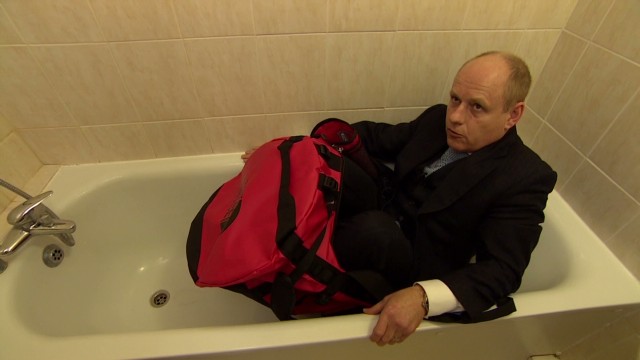
The death of MI6 codebreaker Gareth Williams -- whose naked body was found inside an externally locked bag in his bathtub in 2010 -- was a "perfect crime," a confined spaces expert says.

Watch this video
Peter Faulding said he disagreed with Scotland Yard's conclusion that Williams most likely locked himself in the bag, saying it was his belief that the MI6 worker was murdered.
Last week, London's Metropolitan Police said its three-year investigation had found a lack of evidence to show that someone else had been involved in Williams' death. The police position differs from a 2012 coroner's report, which said it was likely he had been killed.
Faulding testified at the Coroner's inquest and did not definitively rule out that Williams could have somehow locked himself into the bag alone. But he said he could not have done so without leaving evidence.
This week Faulding told CNN he was still of that view, using the same model of bag and a similar type of bathtub to show how Williams could have gotten into the bag and why he held the view that someone else was involved.